Snack Smart, Think Sharp
What your cravings are trying to tell you — and how to snack your way to better brain health.


Welcome to part one of a two part series on cravings, snacking and the foods that keep your brain — and your body — happy. Next week we will dive into main meal swaps, and the other powerful drivers of cravings like hormones and habits. But first, let's start where most people's diets go sideways: snacking.
Part One: Snacks, Cravings and the Sugar Gnome
Did you know that one of the most powerful places to start when improving your diet is not your meals — it is your snacks?
When someone comes to me wanting to eat healthier or lose weight, their snack habits are one of the first things I look at. And the data tells us why. About 95% of American adults snack daily, and nearly 80% eat two or more snacks per day. Snacks now account for roughly one quarter of our total daily calories — and contribute nearly 43% of our added sugar intake. The most commonly consumed snacks are chips, baked desserts, candy, sweetened beverages, and packaged foods. Yikes!
But here is the good news: research suggests the problem is not snacking itself — it is what we are snacking on. Higher quality snacks like nuts, berries, yogurt, hummus, and vegetables can actually support satiety, blood sugar balance, and overall nutrition. The goal is not to stop snacking. It is to snack smarter.
My Sugar Gnome
I have a massive sweet tooth. A steady, reliable urge my husband lovingly calls my “sugar gnome.” For years I thought it was just something to white knuckle through with willpower. What I have learned is that it has very little to do with discipline and everything to do with the habits around my other meals and snacks.
The biggest game changer has been making sure I am getting a balanced intake of nutrients at every meal and being just as intentional about what I reach for between them. As someone naturally drawn to plant based eating, I was often under-eating protein and fat without realizing it. This coupled with a high activity level, and my sugar gnome would come demanding instant energy. Once I started prioritizing protein alongside fiber at my meals, and choosing snacks that pair protein with produce, my cravings became far more manageable. The sugar gnome is still there. But keeping it in check is the name of the game, and I have learned exactly how to do it.
Why We Crave What We Crave
Despite what our brain whispers to us — cravings are not a character flaw. They are biology. Understanding them is the first step to working with them rather than against them.
Cravings are driven by a powerful mix of hormones, habits, and brain chemistry. When ghrelin, our hunger hormone, rises and leptin, our satiety hormone, drops, the brain sends an urgent signal for fast energy. Eating pleasurable foods triggers dopamine — the brain’s feel good chemical — which reinforces the craving and makes us want to repeat it. Over time these patterns become deeply wired.
But here is the key: cravings more often signal a physiological, emotional, or psychological imbalance than an actual nutritional need. They are your body telling you something is off. The craving is the clue. Learning to read it is where the power lies.

What Is Your Body Really Telling You?
The next time a craving hits, pause and ask yourself which of these signals might be driving it:
Physiological — Your body needs fuel Skipping meals, under-eating protein, or letting blood sugar drop too low are the most common drivers of cravings. This kind of hunger tends to sneak up on you with low energy, a foggy mind, and no particular food calling your name. Ask yourself: When did I last eat? Did I get enough protein, fat and carbohydrates at my last meal? Reach for: A handful of nuts with fruit, a hard boiled egg with hummus and vegetables, or edamame with sea salt and EVOO — protein and healthy fat that satisfy without spiking your blood sugar.
Emotional — You are seeking comfort or relief Stress, anxiety, boredom, and sadness send the brain searching for the fastest route to dopamine — usually something sweet or fatty. These cravings feel sudden, specific, and often appear after a stressful moment or at a predictable low point in the day. Ask yourself: Am I actually hungry, or am I feeling something I don’t want to feel? First — pause. Even two minutes of deep breathing can help the wave pass and give you back your choice. Reach for: Something genuinely satisfying — a piece of dark chocolate with a spoonful of nut butter, or a warm bowl of oatmeal with berries and honey.
Dehydration — You may just need water The brain frequently confuses thirst with hunger, and mild dehydration often shows up as a craving for something sweet or salty. It is one of the most overlooked and easiest fixes. Ask yourself: Have I had enough water today? Reach for: A large glass of water first — wait ten minutes. Still hungry? Try sparkling water with citrus, watermelon, celery with hummus, or cucumber with sea salt.
Next week we will go deeper into hormonal and habitual cravings — and how your daily meals are your most powerful tool for keeping them in check.
How to Build a Brain Healthy Snack
The formula is simple: a quality protein paired with produce or a complex carbohydrate. Protein keeps you full and stabilizes blood sugar. Produce and complex carbs provide fiber, antioxidants, and sustained energy. Together they satisfy the craving and nourish your brain.
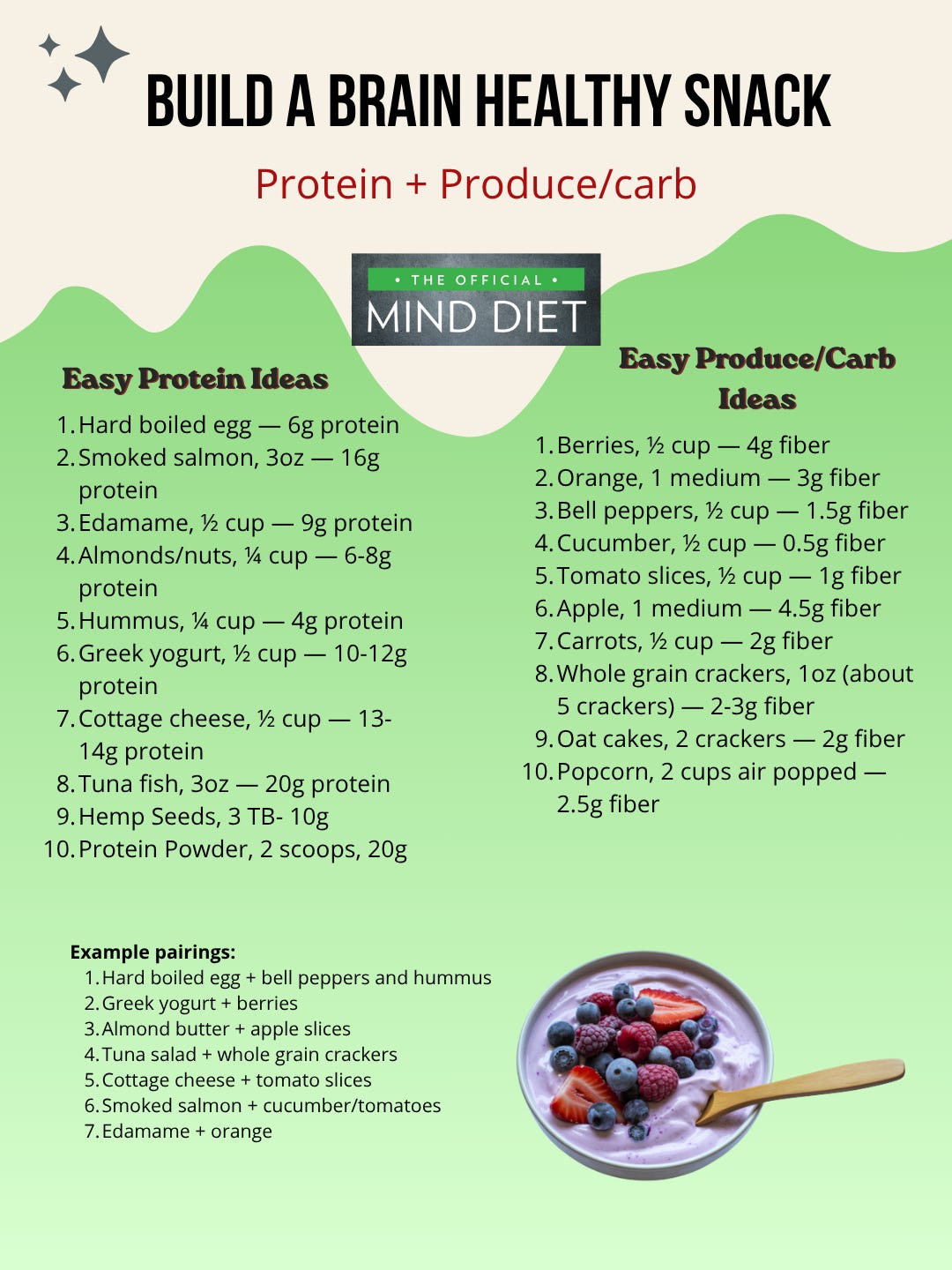
Now for the good part. Below you will find some of my favorite brain healthy snacks — simple, delicious, and built to keep your sugar or salt gnome dormant. These are are some of my favorite recipes, and I think you will love them too.
